Debt to Capital at Book
|
Saturday, March 07, 2009
Debt to Capital at Book


Current Ratio
Definition
An indication of a company's ability to meet short-term debt obligations; the higher the ratio, the more liquid the company is. Current ratio is equal to current assets divided by current liabilities. If the current assets of a company are more than twice the current liabilities, then that company is generally considered to have good short-termfinancial strength. If current liablities exceed current assets, then the company may haveproblems meeting its short-term obligations. For example, if XYZ Company's total current assets are $10,000,000, and its total current liabilities are $8,000,000, then its current ratio would be $10,000,000 divided by $8,000,000, which is equal to 1.25. XYZ Company would be in relatively good short-term financial standing.
Current Liabilities
What Does Current Liabilities Mean?
A company's debts or obligations that are due within one year. Current liabilities appear on the company's balance sheet and include short term debt, accounts payable, accrued liabilities and other debts.
A company's debts or obligations that are due within one year. Current liabilities appear on the company's balance sheet and include short term debt, accounts payable, accrued liabilities and other debts.
Investopedia explains Current Liabilities
Essentially, these are bills that are due to creditors and suppliers within a short period of time. Normally, companies withdraw or cash current assets in order to pay their current liabilities.
Analysts and creditors will often use the current ratio, (which divides current assets by liabilities), or the quick ratio, (which divides current assets minus inventories by current liabilities), to determine whether a company has the ability to pay off its current liabilities.
Essentially, these are bills that are due to creditors and suppliers within a short period of time. Normally, companies withdraw or cash current assets in order to pay their current liabilities.
Analysts and creditors will often use the current ratio, (which divides current assets by liabilities), or the quick ratio, (which divides current assets minus inventories by current liabilities), to determine whether a company has the ability to pay off its current liabilities.
How to Read a Balance Sheet: Current Liabilities
August 21, 2008 |
Current liabilities are what a company currently owes to its suppliers and creditors. These are short-term debts, all due in less than a year. Paying them off normally requires the company to convert some of its current assets into cash.
Beyond simply being bills to pay, liabilities -- confusing as this might sound -- are also a source of assets. Any money that a company pulls from a line of credit, or postpones paying from its accounts payable, is an asset that can be used to grow the business.
There are five main categories of current liabilities:
- Accounts payable
- Accrued expenses
- Income tax payable
- Short-term notes payable
- Portion of long-term debt payable
Accounts payable
This is the money the company currently owes to its suppliers, partners, and employees -- the basic costs of business that the company hasn't yet paid, for whatever reason. One company's accounts payable is another company's accounts receivable, which is why both terms are similarly structured. A company has the power to push back the due dates on some of its accounts payable. Paying those debts later than expected can often produce a short-term increase in earnings and current assets.
This is the money the company currently owes to its suppliers, partners, and employees -- the basic costs of business that the company hasn't yet paid, for whatever reason. One company's accounts payable is another company's accounts receivable, which is why both terms are similarly structured. A company has the power to push back the due dates on some of its accounts payable. Paying those debts later than expected can often produce a short-term increase in earnings and current assets.
Accrued expenses
The company has racked up these bills, but not yet paid them. These are normally marketing and distribution expenses that are billed on a set schedule and have not yet come due.
The company has racked up these bills, but not yet paid them. These are normally marketing and distribution expenses that are billed on a set schedule and have not yet come due.
Income tax payable
This is a specific type of accrued expense -- the income tax a company accrues over the year, but does not have to pay yet, according to various federal, state and local tax schedules. Although they're subject to withholding, some taxes simply are not accrued by the government over the course of the quarter or the year. Instead, they're paid in lump sums whenever the bill is due.
This is a specific type of accrued expense -- the income tax a company accrues over the year, but does not have to pay yet, according to various federal, state and local tax schedules. Although they're subject to withholding, some taxes simply are not accrued by the government over the course of the quarter or the year. Instead, they're paid in lump sums whenever the bill is due.
Short-term notes payable
The company has drawn off this amount from its line of credit from a bank or other financial institution. It needs to be repaid within the next 12 months.
The company has drawn off this amount from its line of credit from a bank or other financial institution. It needs to be repaid within the next 12 months.
Portion of long-term debt
This represents a chunk of a company's longer-term obligations that may come due in a given year or quarter. That's why it's counted as a current liability, even though it's called "long term."
This represents a chunk of a company's longer-term obligations that may come due in a given year or quarter. That's why it's counted as a current liability, even though it's called "long term."
Share buy back
What Does Buyback Mean?
The repurchase of outstanding shares (repurchase) by a company in order to reduce the number of shares on the market. Companies will buy back shares either to increase the value of shares still available (reducing supply), or to eliminate any threats by shareholders who may be looking for a controlling stake.
The repurchase of outstanding shares (repurchase) by a company in order to reduce the number of shares on the market. Companies will buy back shares either to increase the value of shares still available (reducing supply), or to eliminate any threats by shareholders who may be looking for a controlling stake.
Investopedia explains Buyback
A buyback allows companies to invest in themselves. By reducing the number of shares outstanding on the market, buybacks increase the proportion of shares a company owns. Buybacks can be carried out in two ways:
1. Shareholders may be presented with a tender offer whereby they have the option to submit (or tender) a portion or all of their shares within a certain time frame and at a premium to the current market price. This premium compensates investors for tendering their shares rather than holding on to them.
2. Companies buy back shares on the open market over an extended period of time.
A buyback allows companies to invest in themselves. By reducing the number of shares outstanding on the market, buybacks increase the proportion of shares a company owns. Buybacks can be carried out in two ways:
1. Shareholders may be presented with a tender offer whereby they have the option to submit (or tender) a portion or all of their shares within a certain time frame and at a premium to the current market price. This premium compensates investors for tendering their shares rather than holding on to them.
2. Companies buy back shares on the open market over an extended period of time.
The Benefits of Stock Buy Back Programs
The Golden Egg of Shareholder Value
By Joshua Kennon, About.com
All investors have no doubt heard of corporations authorizing share buy back programs. Even if you don't know what they are or how they work, you at least understand that they are a good thing (in most situations). Here are three important truths about these programs - and most importantly, how they make your portfolio grow.
Principle 1: Overall growth is not nearly as important as growth per share
Too often, you'll hear leading financial publications and broadcast talking about the overall growth rate of a company. While this number is very important in the long run, it is not the all-important factor in deciding how fast your equity in the company will grow. Growth per share is.
An over-simplified example may help. Let's look at a fictional company:
Eggshell Candies, Inc.
$50 per share
100,000 shares outstanding
-------------------------------------------
Market Capitalization: $5,000,000
This year, the company made a profit of $1 million dollars.
==================================
In this example, each share equals .001% of ownership in the company. (100% divided by 100,000 shares.)
Management is upset by the company's performance because it sold the exact same amount of candy this year as it did last year. That means the growth rate is 0%! The executives want to do something to make the shareholders money because of the disappointing performance this year, so one of them suggests a stock buyback program. The others immediately agree; the company will use the $1 million profit it made this year to buy stock in itself.
So the very next day, the CEO goes and takes the $1 million dollars out of the bank and buys 20,000 shares of stock in his company. (Remember it is trading at $50 a share according to the information above.) Immediately, he takes the shares to the Board of Directors, and they vote to destroy them so that they no longer exist. This means that now there are only 80,000 shares of Eggshell Candies in existence instead of the original 100,000.
What does that mean to you? Each share you own no longer represents .001% of the company. Instead, it represents .00125%; that's a 25% increase in value per share! The next day you wake up and find out that your stock in Eggshell is now worth $62.50 per share instead of $50. Even though the company didn't grow this year, you still made a twenty five percent increase on your investment! This leads to the second principle.
Principle 2: When a company reduces the amount of shares outstanding by declaring a stock buy back program, each of your shares becomes more valuable and represents a greater percentage of equity in the company.
If a shareholder-friendly management such as this one is kept in place, it is possible that someday there may only be five shares of the company, each worth one million dollars. When putting together your portfolio, you should seek out businesses that engage in these sorts of pro-shareholder practices and hold on to them as long as the fundamentals remain sound. One of the best examples is the Washington Post, which was at one time only $5 to $10 a share. It has traded as high as $650 in recent months. That is long term value!
Principle 3: Stock buy back programs are not good if the company pays too much for its own stock!
Even though buybacks can be huge sources of long-term profit for investors, they are actually harmful if a company pays more for its stock than it is worth. In an overpriced market, it would be foolish for management to purchase equity at all, even in itself.
Instead, the company should put the money into assets that can be easily converted back into cash. This way, when the market swung the other way and is trading below its true value, shares of the company can be bought back up at a discount, ensuring current shareholders receive maximum benefit. Remember, even the best investment in the world isn't a good investment if you pay too much for it.
Sunday, March 01, 2009
Inventories
When looking at a company's current assets, you need to pay special attention to inventory. Inventory consists of merchandise a business owns but has not sold. It is classified as a current assets because investors assume that inventory can be sold in the near future, turning it into cash.
To come up with a balance sheet amount, companies must estimate the value of their inventory. For instance, if Nintendo had 5,000 units of its new video game system, the Game Cube, sitting in a warehouse in Japan, and expected to sell them to retailers for $300 each, they would be able to put $1,500,000 on their balance sheet as the value of their current inventory (5000 units x $300 each = $1.5 million).
This presents an interesting problem. When inventory piles up, it faces two major risks. The first is the risk of obsolesce. In another year, few stores will probably be willing to buy the Game Cube video game system for $300 simply because a newer, faster, and better system may have come along. Although the inventory is carried on the balance sheet at $1.5 million, it may actually lose value as time passes. When you hear that a company has taken an inventory write-off charge, it means that management essentially decided the products that were sitting in storage or on the store shelves weren't worth the values they were stated at on the balance sheet. To correct this, the company will reduce the carrying value of its inventory.
If a year passes and Nintendo still has 3000 of the 5000 units in storage, the executives may decide to lower their prices hoping to sell the remaining inventory. If they lower the Game Cube's price to $200 each, they would have 3000 units at $200. Before, those 3000 units were stated at a value of $900,000 on the balance sheet. Now, because they are selling for less, the same units are only worth $600,000. The risk of obsolesce is especially present in technology companies or manufacturers of heavy machinery.
Another inventory risk is spoilage. Spoilage occurs when a product actually goes bad. This is a serious concern for companies that make or sell perishable goods. If a grocery store owner overstocks on ice cream, and two months later, half of the ice cream has gone bad because it has not been purchased, the grocer has no choice but to throw it out. The estimated value of the spoiled ice cream must be taken off the grocery store's balance sheet.
The moral of the story: the faster a company sells its inventory, the smaller the risk of value loss.
Calculating Asset Turnover
Calculating Asset Turnover
The asset turnover ratio calculates the total sales [revenue] for every dollar of assets a company owns. To calculate asset turnover, take the total revenue and divide it by the average assets for the period studied. [Note: you should know how to do this. In lesson 3 we took the average inventory and receivables for certain equations. The process is the same; take the beginning assets and average them with the ending assets. If XYZ had $1 in assets in 2000 and $10 in assets in 2001, the average asset value for the period is $5 because $1+$10 divided by 2 = $5]. A quick exercise would benefit your understanding.
The asset turnover ratio calculates the total sales [revenue] for every dollar of assets a company owns. To calculate asset turnover, take the total revenue and divide it by the average assets for the period studied. [Note: you should know how to do this. In lesson 3 we took the average inventory and receivables for certain equations. The process is the same; take the beginning assets and average them with the ending assets. If XYZ had $1 in assets in 2000 and $10 in assets in 2001, the average asset value for the period is $5 because $1+$10 divided by 2 = $5]. A quick exercise would benefit your understanding.
Friday, January 30, 2009
Peres, Erdogan in 'amicable talks' after Davos spat
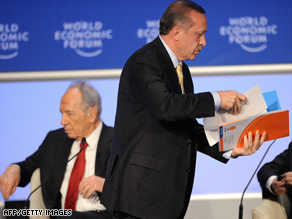
(CNN) -- Israeli President Shimon Peres said he had an amicable phone conversation with Turkish Prime Minister Recep Tayyip Erdogan, a day after Erdogan stormed offstage during an angry exchange with Peres at the World Economic Forum in Davos, Switzerland.
Turkish PM Recep Tayyip Erdogan leaves the stage Thursday, as Israeli President Shimon Peres sits, left.
Turkish PM Recep Tayyip Erdogan leaves the stage Thursday, as Israeli President Shimon Peres sits, left.
var CNN_ArticleChanger = new CNN_imageChanger('cnnImgChngr','/2009/WORLD/europe/01/30/davos.erdogan.peres/imgChng/p1-0.init.exclude.html',1,1);
//CNN.imageChanger.load('cnnImgChngr','imgChng/p1-0.exclude.html');
Peres said he and Erdogan did not take the spat personally.
"I called him up and said, yes, it's nothing against you, nothing against Turkey. We consider you as a friend," Peres said. He said Erdogan reciprocated.
Although there was no mention of an apology, Peres said there was a polite exchange between the two leaders.
"I didn't take it personally. I didn't go for a personal fight. I answered unfounded accusations. It was my duty. And they didn't change my mind," he said.
Turkey, a predominantly Muslim nation, has long been the Jewish state's closest military and economic partner in the region, and Turkey recently mediated indirect peace talks between Israel and Syria.
But many Turks have been incensed with Israel over its three-week military operation that ended there earlier this month.
And in Davos, Erdogan was angered after Peres said that Israel is committed to peace and blamed Hamas for the fighting in Gaza, where Israel staged a three-week military operation that ended earlier this month.
When Erdogan began responding, a moderator cut him off, saying the debate had run over its allotted time. Erdogan patted the moderator on the arm until he was granted one more minute to respond. Watch commentary on Erdogan's angry exchange »
"I know the reason behind raising your voice is because of the guilty psychology," he said to Peres. "My voice will not be that loud. You must know that. When it comes to killing -- you know killing very well. I know how you hit, kill children on the beaches."
He then left the stage, complaining that Peres was receiving preferential treatment.
"From now on, Davos is finished for me," Erdogan said. "I will not come back. You won't let people talk. You gave him 25 minutes, but you gave me 12 minutes. This is not right."
Don't Miss
Erdogan had described the military campaign against Hamas fighters in Gaza as "barbaric" and accused Israel of using excessive force.
He said: "The Palestinian Territories are like an open-air prison, isolated from the world. I have always been a leader who said anti-Semitism is a crime against humanity. But so is anti-Islamism."
Peres had said Hamas was responsible for the "tragedy," accusing the Islamist militants of creating a "dangerous dictatorship."
"Israel left Gaza completely -- no occupation," Peres said. "I want to understand why they throw rockets at us."
On Friday, after his outburst, Erdogan returned home to a hero's welcome. Thousands of people lined up at Ataturk Airport in Istanbul, cheering and waving signs. A large banner read, "You Will Never Walk Alone," and smaller signs bore phrases including "Davos Conqueror." People also were seen waving Turkish and Palestinian flags and throwing flowers on the road leading to Erdogan's home.
Despite the glowing response at the airport, there has been some criticism in the Turkish media of Erdogan's exchange with the Israeli president.
Erdogan explained whom he was directing his anger at during a news conference at the airport. "My words were only to the Israeli government, not the Israeli people," he said.
Wednesday, January 28, 2009
Senators look into Madoff case
WASHINGTON: A multibillion-dollar pyramid scheme allegedly spawned by disgraced investor Bernard Madoff is being probed by a Senate panel that will, for the first time, question federal regulators responsible for inspecting investment firms and enforcing action against violations.
The Securities and Exchange Commission has faced heavy criticism over its failure to discover the US$50 billion Ponzi scheme allegedly run by Madoff, the prominent Wall Street figure and money manager now fallen into disgrace, despite credible allegations against him being brought to the agency over the course of a decade.
Against the backdrop of the worst financial crisis since the 1930s, the SEC also is being accused of contributing to that disaster with lax oversight of Wall Street and the markets, and lawmakers of both parties are calling for a shakeup of the agency to help restore investor confidence.
The Senate Banking Committee was to take testimony at a hearing Tuesday from SEC Enforcement Director Linda Thomsen and the director of the agency’s inspections office, Lori Richards.
Also to appear before the panel was Stephen Luparello, the interim chief executive of the Financial Industry Regulatory Authority, the securities industry’s self-policing organization.
Sen. Christopher Dodd of Connecticut, the banking panel’s chairman, recently asked Mary Schapiro - President Barack Obama’s newly confirmed chairman of the SEC - about the failure of the industry regulatory agency to detect the alleged Madoff fraud in its inspections of his brokerage operation.
Schapiro, who has led FINRA as its CEO since 2006, said that the matter went undiscovered because the scheme was carried out through Madoff’s investment business and FINRA was empowered to inspect only the brokerage operation.
After acknowledging last month that staff members at the SEC repeatedly failed since at least 1999 to fully investigate Madoff’s operations, then-SEC Chairman Christopher Cox ordered the agency’s inspector general, H. David Kotz, to determine what went wrong.
Kotz told a House hearing recently that he was expanding the inquiry to examine the operations of the divisions led by Thomsen, who has been the enforcement chief since mid-2005, and Richards, who has held that position since mid-1995.
Among other facets, Kotz has been examining the relationship between a former SEC attorney, Eric Swanson, and Madoff’s niece, Shana, who are now married.
As an SEC attorney, Swanson was part of a team that examined Madoff’s brokerage operation in 1999 and 2004.
Neither review resulted in any action against Madoff, a former chairman of the Nasdaq Stock Market who was a member of SEC advisory committees.
Lawmakers say Madoff’s alleged fraud, which caused massive damage to investors large and small around the world and may be the largest pyramid scam in history, reflects deep, systemic problems at the SEC.
The Banking Committee is examining the case “to determine how so many people could have been deceived and how such a massive fraud could have gone undetected for so long,” Dodd said in a statement recently.
“American investors deserve an explanation and the responsible parties must be held accountable. I am hopeful that our findings will also help inform our efforts to improve regulation so that such abuses do not occur in the future.”
The committee has requested an extensive array of documents related to Madoff from the SEC.
Six weeks after Madoff’s arrest in New York, thousands of victims who lost money investing with him have been identified - including ordinary people and Hollywood celebrities as well as big hedge funds, international banks and charities in the US, Europe and Asia.
In Brussels, Belgium, on Monday, the European Union said it would check investor protection rules in all 27 member nations after France complained of lax standards that saw French investors lose billions of euros in the scandal.
The checking should clarify how far European funds could be held responsible for placing client money with Madoff - and whether they could be ordered to compensate investors.
FINRA recently sent letters to its approximately 5,100 member brokerage firms asking whether they referred any customers to Madoff’s firm.
Also slated to testify at Tuesday’s hearing was Stephen Harbeck, president of the Securities Investor Protection Corp. (SPIC), an industry-funded organization that steps in when a brokerage firm fails.
The group can provide funds up to a maximum of US$500,000 for each customer of the failed firm.
The estimated US$50bil in losses from Madoff dwarfs the US$1.6bil currently available to SIPC. -- AP
Tuesday, January 27, 2009
Frederic Oumar Kanoute Menjulang Palestin di Arena Bolasepak Antarabangsa
Posted by : shahnor77 on Tuesday, January 27, 2009 - 01:13 PM CCT 74 Reads  Printer Friendly Page Printer Friendly Page | ||||
 |
| |||

 .
.Saturday, January 24, 2009
Siapa Yahudi? Siapa Orang Islam?
Siapa Yahudi? Siapa Orang Islam?
SEJAK 18 hari ini seluruh dunia meratap gara-gara kezaliman Israel. Tentera Zionis terus-menerus mengebom, mengganyang rakyat Palestin. Israel, nampaknya terlalu berkuasa.
Saya tidak 'berkuasa' lagi untuk mengulas panjang mengenai peperangan sebelah pihak itu. Tapi saya ingin berkongsi dengan pembaca sekelian, siapa sebenarnya Yahudi ini dan mengapa mereka terlalu berkuasa.
Kita harus kaji secara akademik, ilmiah untuk mengetahui siapa mereka ini.
Saya amat tertarik dengan tulisan seorang penulis bebas, yang juga Pengarah Eksekutif Pusat Penyelidikan dan Kajian Keselamatan (CRSS) Pakistan, Dr. Farrukh Saleem (rujuk http://www.masada2000.org/Powerful-Jews.html) mengenai soal tersebut. Jadikanlah tulisan itu sebagai tatapan dan renungan kita semua - ke mana kita dan ke mana umat Islam harus pergi selepas ini. Dan, siapa yang harus disalahkan? (Nota: Sedikit sebanyak ia juga akan menjawab surat-surat dan SMS yang dihantar untuk ruangan Forum, Utusan Malaysia yang meminta ditonjolkan apakah produk di belakangnya Yahudi).
Begini tulisan beliau:
Hanya ada 14 juta Yahudi di muka bumi ini; tujuh juta di Amerika, lima juta di Asia, dua juta di Eropah dan 100,000 di Afrika. Bagi setiap orang Yahudi ada 100 orang Muslim (1:100). Namun, jika dicampur semua sekali, Yahudi lebih 100 kali berkuasa daripada orang Islam. Mengapa ini berlaku?
Siapa mereka ini?
Nabi Isa (Jesus of Nazareth) ialah Yahudi. Albert Einstein, saintis zaman moden paling terkemuka dan disebut oleh majalah Time sebagai 'Manusia Abad ini' ialah seorang Yahudi; Sigmund Freud - melalui teori id, ego dan super-ego ialah bapa psikoanalisis, juga seorang Yahudi; begitu juga Karl Marx, Paul Samuelson dan Milton Friedman.
Selain mereka banyak lagi orang Yahudi yang hasil kebijaksanaan mereka berupaya menghasilkan keperluan untuk kita semua: Benjamin Rubin memperkenalkan jarum suntikan pelalian.
Johas Salk mereka vaksin polio yang pertama. Gertrude Elion mencipta ubat melawan leukemia. Baruch Blumberg mencipta vaksin Hepatitis B. Paul Ehrlich menemukan rawatan untuk siflis. Elie Metchnikoff menang Hadiah Nobel untuk penyakit berjangkit. Bernard Katz menang Hadiah Nobel kerana kajian mengenai transmisi neuromuskular.
Andrew Schally penerima Nobel dalam kajian endokrinologi (berkaitan sistem endokrin dan kencing manis). Aaron Beck menemui terapi kognitif (rawatan mental, kesugulan dan fobia).
Gregory Pincus membangunkan pil perancang keluarga yang pertama. George Wald menang Nobel bagi kajian mata manusia, Standley Cohen dianugerahi Hadiah Nobel dalam kajian embriologi (kajian janin dan perkembangannya). Willem Kolff mencipta mesin dialisis (mencuci) buah pinggang.
Sejak 105 tahun, 14 juta Yahudi menang 15 dozen Hadiah Nobel, sementara tiga dimenangi oleh 1.4 bilion umat Islam.
Stanley Mezor mencipta mikrocip pertama. Leo Szilards membangunkan reaktor rangkaian nuklear pertama; Peter Schultz (kabel gentian optik); Charles Adler (lampu isyarat); Benno Strauss (besi tahan karat - stainless steel); Isador Kisee (sistem suara di pawagam); Emile Berliner (mikrofon untuk telefon) dan Charles Ginsburg (alat pita rakaman).
Saudagar jenama terkaya dunia juga dikuasai Yahudi iaitu Ralph Lauren (Polo), Levis Strauss (Levi's Jeans), Howard Schultz (Starbuck's), Sergey Brin (Google), Michael Dell (Dell Computers), Larry Ellison (Oracle), Donna Karan (DKNY), Irv Robbins (Baskin & Robbins) dan Bill Rossenberg (Dunkin Donuts).
Richard Levin, presiden universiti tersohor Yale Universiti ialah seorang Yahudi. Henry Kissinger, Joseph Lieberman dan Madeleine Albright (bekas-bekas Setiausaha Negara AS); Alan Greenspan (bekas pengerusi Rizab Persekutuan AS di bawah Reagan, Bush, Clinton dan Bush); Maxim Litvinov (bekas Menteri Luar Soviet Union); David Marshal (bekas Ketua Menteri pertama Singapura); Isaac Isaacs (bekas Gabenor Jeneral Australia); Benjamin Disraeli (negarawan dan penulis Britian); Yevgeny Primkov (bekas Perdana Menteri Rusia dan bekas jeneral KGB); Jorge Sampaio (bekas Presiden Portugal); Herb Gray (bekas Timbalan Perdana Menteri Kanada); Pierre Mendes (Perdana Menteri ke-143 Perancis); Michael Howard (bekas Setiausaha Negara British); Bruno Kreisky (bekas Canselor Austria) dan Robert Rubin (bekas Setiausaha Perbendaharaan AS).
Dalam dunia media, orang Yahudi yang terkemuka ialah Wolf Blitzer (CNN); Barbara Walters (ABC News); Eugene Meyer (Washington Post); Henry Grunwald (Ketua Editor Time); Katherine Graham (penerbit The Washington Post); Joseph Lelyyeld (Editor Eksekutif, The New York Times) dan Max Frankel (The New York Times).
Dermawan dan penyangak mata wang, George Soros ialah Yahudi. Dia menderma AS$4 bilion untuk membantu ahli sains dan universiti serata dunia.
Walter Annenberg menderma untuk membina ratusan perpustakaan berjumlah AS$2 bilion.
Di Olimpik, Mark Spitz membolot tujuh pingat emas. Lenny Krayzelburg ialah pemegang tiga kali pingat emas Olimpik. Spitz Krayzelburg dan Boris Becker adalah Yahudi.
Tahukah anda bahawa pelakon pujaan Harrison Ford, George Burns, Tony Curtis, Charles Bronson, Sandra Bullock, Billy Cystal, Woody Allen, Paul Newman, Peter Sellers, Dustin Hoffman, Michael Douglas, Ben Kingsley, Kirk Douglas, Willian Shatner, Jerry Lewis dan Peter Falk semuanya Yahudi?
Tambahan lagi, Hollywood sendiri diwujudkan oleh orang Yahudi. Antara pengarah dan penerbit, Steven Spielberg, Mel Brooks, Oliver Stone, Aaron Spelling (Beverly Hills 90210), Neil Simon (The Odd Couple), Andrew Vaina (Rambo 1- 2-3), Michael Man (Starsky and Hutch), Milos Forman (One Flew Over The Cuckoo's Nest), Douglas Fairbanks (The Thief Of Baghdad) and Ivan Reitman (Ghostbusters) - semuanya adalah Yahudi.
Mempengaruhi
Washington yang merupakan ibu negara Amerika Syarikat, mempunyai satu pertubuhan lobi yang amat berkuasa. Ia dikenali sebagai Jawatankuasa Hal Ehwal Awam Amerika Israel (AIPAC) yang berupaya mempengaruhi Kongres meluluskan resolusi memuji dan 'membuat apa saja' demi Israel.
Tahukah lagi bahawa William James Sidis dengan IQ 250-300 ialah manusia tercerdik. Dia ialah Yahudi.
Jadi, mengapa mereka ini terlalu berkuasa?
Jawapannya: Pendidikan, pelajaran, ilmu.
Mengapa umat Islam terlalu lemah?
Dianggarkan 1,476,233,470 Muslim di atas muka bumi Allah ini. Satu bilion di Asia, 400 juta di Afrika, 44 juta di Eropah dan enam juta di Amerika. Setiap lima insan manusia ialah Muslim. Setiap seorang Hindu ada dua orang Islam, setiap seorang Buddha ada dua orang Islam dan setiap seorang Yahudi ada beratus orang Islam. Mengapa orang Islam terlalu lemah?
Ini jawapannya: Terdapat 57 negara anggota OIC dan jika dicampur semua cuma ada kira-kira 500 buah universiti; atau sebuah universiti untuk setiap tiga juta orang Islam.
AS mempunyai 5,758 universiti dan India ada 8,407. Pada 2004, Shanghai Jiao Tong Universiti membuat kajian 'Kedudukan Akademik Universiti-universiti Dunia' - dan menakjubkan - tiada satu pun universiti-negara Islam yang berada di puncak 500.
Data yang dikumpul dari UNDP, tahap celik huruf di negara maju ialah hampir 90 peratus dan 15 negara itu mempunyai 100 peratus celik huruf. Negara majoriti penduduk Islam, purata kadar celik huruf ialah sekitar 40 peratus dan tiada negara yang mempunyai 100 peratus semuanya celik huruf.
Sekitar 98 peratus penduduk di negara maju menamatkan sekurang-kurang sekolah rendah, sementara hanya 50 peratus di negara majoriti Islam. Sekitar 40 peratus penduduk di negara maju memasuki universiti, sementara hanya 2 peratus di negara majoriti Islam.
Negara-negara majoriti Islam mempunyai 230 ahli sains bagi setiap (per) sejuta penduduk. Di AS 4,000 per sejuta, Jepun 5,000 per sejuta. Di seluruh negara Arab, penyelidik sepenuh masa ialah 35,000 dan hanya 50 juruteknik per sejuta (berbanding di negara maju 1,000 juruteknik per sejuta).
Negara Islam membelanjakan 0.2 peratus daripada KDNK untuk penyelidikan dan pembangunan (R&D) sebaliknya, di negara maju membelanjakan 5 peratus daripada KDNKnya.
Kesimpulan: Dunia Islam kurang keupayaan untuk menghasilkan ilmu pengetahuan.
Akhbar harian yang dibaca oleh setiap 1,000 orang dan jumlah judul buku yang dibaca oleh setiap sejuta orang adalah dua angka tunjuk bagi menentukan sama ada ilmu pengetahuan disalurkan ke dalam masyarakat.
Di Pakistan, hanya ada 23 akhbar harian per 1,000 rakyat Pakistan sementara nisbah di Singapura ialah 360. Di UK, jumlah judul buku per juta orang ialah 2,000 sementara di Mesir ialah 20.
Kesimpulan: Dunia Islam gagal menyalurkan ilmu pengetahuan.
Yang menariknya, jumlah terkumpul KDNK tahunan 57 buah negara ahli OIC ialah di bawah AS$2 trilion. Amerika sahaja, menghasilkan barangan dan perkhidmatan bernilai AS$12 trilion, China AS$8 trilion, Jepun AS$3.8 trilion dan Jerman AS$2.4 trilion.
Pengeluar minyak yang kaya, Arab Saudi, UAE, Kuwait, Qatar secara rangkuman menghasilkan barangan dan perkhidmatan (rata-rata minyak) bernilai AS$500 bilion; Sepanyol sahaja menghasilkan barangan dan perkhidmatan bernilai lebih AS$1 trilion, Poland AS$489 bilion dan Thailand AS$545 bilion.
Jadi, mengapa orang Islam tidak berkuasa dan orang Yahudi paling berkuasa?
Jawapannya ialah: Kurangnya ilmu. Kurangnya pendidikan dan kurangnya pelajaran.
http://www.utusan.com.my/utusan/info.asp?y=2009&dt=0114&pub=Utusan_Malaysia&sec=Muka_Hadapan&pg=mh_06.htm
SEJAK 18 hari ini seluruh dunia meratap gara-gara kezaliman Israel. Tentera Zionis terus-menerus mengebom, mengganyang rakyat Palestin. Israel, nampaknya terlalu berkuasa.
Saya tidak 'berkuasa' lagi untuk mengulas panjang mengenai peperangan sebelah pihak itu. Tapi saya ingin berkongsi dengan pembaca sekelian, siapa sebenarnya Yahudi ini dan mengapa mereka terlalu berkuasa.
Kita harus kaji secara akademik, ilmiah untuk mengetahui siapa mereka ini.
Saya amat tertarik dengan tulisan seorang penulis bebas, yang juga Pengarah Eksekutif Pusat Penyelidikan dan Kajian Keselamatan (CRSS) Pakistan, Dr. Farrukh Saleem (rujuk http://www.masada2000.org/Powerful-Jews.html) mengenai soal tersebut. Jadikanlah tulisan itu sebagai tatapan dan renungan kita semua - ke mana kita dan ke mana umat Islam harus pergi selepas ini. Dan, siapa yang harus disalahkan? (Nota: Sedikit sebanyak ia juga akan menjawab surat-surat dan SMS yang dihantar untuk ruangan Forum, Utusan Malaysia yang meminta ditonjolkan apakah produk di belakangnya Yahudi).
Begini tulisan beliau:
Hanya ada 14 juta Yahudi di muka bumi ini; tujuh juta di Amerika, lima juta di Asia, dua juta di Eropah dan 100,000 di Afrika. Bagi setiap orang Yahudi ada 100 orang Muslim (1:100). Namun, jika dicampur semua sekali, Yahudi lebih 100 kali berkuasa daripada orang Islam. Mengapa ini berlaku?
Siapa mereka ini?
Nabi Isa (Jesus of Nazareth) ialah Yahudi. Albert Einstein, saintis zaman moden paling terkemuka dan disebut oleh majalah Time sebagai 'Manusia Abad ini' ialah seorang Yahudi; Sigmund Freud - melalui teori id, ego dan super-ego ialah bapa psikoanalisis, juga seorang Yahudi; begitu juga Karl Marx, Paul Samuelson dan Milton Friedman.
Selain mereka banyak lagi orang Yahudi yang hasil kebijaksanaan mereka berupaya menghasilkan keperluan untuk kita semua: Benjamin Rubin memperkenalkan jarum suntikan pelalian.
Johas Salk mereka vaksin polio yang pertama. Gertrude Elion mencipta ubat melawan leukemia. Baruch Blumberg mencipta vaksin Hepatitis B. Paul Ehrlich menemukan rawatan untuk siflis. Elie Metchnikoff menang Hadiah Nobel untuk penyakit berjangkit. Bernard Katz menang Hadiah Nobel kerana kajian mengenai transmisi neuromuskular.
Andrew Schally penerima Nobel dalam kajian endokrinologi (berkaitan sistem endokrin dan kencing manis). Aaron Beck menemui terapi kognitif (rawatan mental, kesugulan dan fobia).
Gregory Pincus membangunkan pil perancang keluarga yang pertama. George Wald menang Nobel bagi kajian mata manusia, Standley Cohen dianugerahi Hadiah Nobel dalam kajian embriologi (kajian janin dan perkembangannya). Willem Kolff mencipta mesin dialisis (mencuci) buah pinggang.
Sejak 105 tahun, 14 juta Yahudi menang 15 dozen Hadiah Nobel, sementara tiga dimenangi oleh 1.4 bilion umat Islam.
Stanley Mezor mencipta mikrocip pertama. Leo Szilards membangunkan reaktor rangkaian nuklear pertama; Peter Schultz (kabel gentian optik); Charles Adler (lampu isyarat); Benno Strauss (besi tahan karat - stainless steel); Isador Kisee (sistem suara di pawagam); Emile Berliner (mikrofon untuk telefon) dan Charles Ginsburg (alat pita rakaman).
Saudagar jenama terkaya dunia juga dikuasai Yahudi iaitu Ralph Lauren (Polo), Levis Strauss (Levi's Jeans), Howard Schultz (Starbuck's), Sergey Brin (Google), Michael Dell (Dell Computers), Larry Ellison (Oracle), Donna Karan (DKNY), Irv Robbins (Baskin & Robbins) dan Bill Rossenberg (Dunkin Donuts).
Richard Levin, presiden universiti tersohor Yale Universiti ialah seorang Yahudi. Henry Kissinger, Joseph Lieberman dan Madeleine Albright (bekas-bekas Setiausaha Negara AS); Alan Greenspan (bekas pengerusi Rizab Persekutuan AS di bawah Reagan, Bush, Clinton dan Bush); Maxim Litvinov (bekas Menteri Luar Soviet Union); David Marshal (bekas Ketua Menteri pertama Singapura); Isaac Isaacs (bekas Gabenor Jeneral Australia); Benjamin Disraeli (negarawan dan penulis Britian); Yevgeny Primkov (bekas Perdana Menteri Rusia dan bekas jeneral KGB); Jorge Sampaio (bekas Presiden Portugal); Herb Gray (bekas Timbalan Perdana Menteri Kanada); Pierre Mendes (Perdana Menteri ke-143 Perancis); Michael Howard (bekas Setiausaha Negara British); Bruno Kreisky (bekas Canselor Austria) dan Robert Rubin (bekas Setiausaha Perbendaharaan AS).
Dalam dunia media, orang Yahudi yang terkemuka ialah Wolf Blitzer (CNN); Barbara Walters (ABC News); Eugene Meyer (Washington Post); Henry Grunwald (Ketua Editor Time); Katherine Graham (penerbit The Washington Post); Joseph Lelyyeld (Editor Eksekutif, The New York Times) dan Max Frankel (The New York Times).
Dermawan dan penyangak mata wang, George Soros ialah Yahudi. Dia menderma AS$4 bilion untuk membantu ahli sains dan universiti serata dunia.
Walter Annenberg menderma untuk membina ratusan perpustakaan berjumlah AS$2 bilion.
Di Olimpik, Mark Spitz membolot tujuh pingat emas. Lenny Krayzelburg ialah pemegang tiga kali pingat emas Olimpik. Spitz Krayzelburg dan Boris Becker adalah Yahudi.
Tahukah anda bahawa pelakon pujaan Harrison Ford, George Burns, Tony Curtis, Charles Bronson, Sandra Bullock, Billy Cystal, Woody Allen, Paul Newman, Peter Sellers, Dustin Hoffman, Michael Douglas, Ben Kingsley, Kirk Douglas, Willian Shatner, Jerry Lewis dan Peter Falk semuanya Yahudi?
Tambahan lagi, Hollywood sendiri diwujudkan oleh orang Yahudi. Antara pengarah dan penerbit, Steven Spielberg, Mel Brooks, Oliver Stone, Aaron Spelling (Beverly Hills 90210), Neil Simon (The Odd Couple), Andrew Vaina (Rambo 1- 2-3), Michael Man (Starsky and Hutch), Milos Forman (One Flew Over The Cuckoo's Nest), Douglas Fairbanks (The Thief Of Baghdad) and Ivan Reitman (Ghostbusters) - semuanya adalah Yahudi.
Mempengaruhi
Washington yang merupakan ibu negara Amerika Syarikat, mempunyai satu pertubuhan lobi yang amat berkuasa. Ia dikenali sebagai Jawatankuasa Hal Ehwal Awam Amerika Israel (AIPAC) yang berupaya mempengaruhi Kongres meluluskan resolusi memuji dan 'membuat apa saja' demi Israel.
Tahukah lagi bahawa William James Sidis dengan IQ 250-300 ialah manusia tercerdik. Dia ialah Yahudi.
Jadi, mengapa mereka ini terlalu berkuasa?
Jawapannya: Pendidikan, pelajaran, ilmu.
Mengapa umat Islam terlalu lemah?
Dianggarkan 1,476,233,470 Muslim di atas muka bumi Allah ini. Satu bilion di Asia, 400 juta di Afrika, 44 juta di Eropah dan enam juta di Amerika. Setiap lima insan manusia ialah Muslim. Setiap seorang Hindu ada dua orang Islam, setiap seorang Buddha ada dua orang Islam dan setiap seorang Yahudi ada beratus orang Islam. Mengapa orang Islam terlalu lemah?
Ini jawapannya: Terdapat 57 negara anggota OIC dan jika dicampur semua cuma ada kira-kira 500 buah universiti; atau sebuah universiti untuk setiap tiga juta orang Islam.
AS mempunyai 5,758 universiti dan India ada 8,407. Pada 2004, Shanghai Jiao Tong Universiti membuat kajian 'Kedudukan Akademik Universiti-universiti Dunia' - dan menakjubkan - tiada satu pun universiti-negara Islam yang berada di puncak 500.
Data yang dikumpul dari UNDP, tahap celik huruf di negara maju ialah hampir 90 peratus dan 15 negara itu mempunyai 100 peratus celik huruf. Negara majoriti penduduk Islam, purata kadar celik huruf ialah sekitar 40 peratus dan tiada negara yang mempunyai 100 peratus semuanya celik huruf.
Sekitar 98 peratus penduduk di negara maju menamatkan sekurang-kurang sekolah rendah, sementara hanya 50 peratus di negara majoriti Islam. Sekitar 40 peratus penduduk di negara maju memasuki universiti, sementara hanya 2 peratus di negara majoriti Islam.
Negara-negara majoriti Islam mempunyai 230 ahli sains bagi setiap (per) sejuta penduduk. Di AS 4,000 per sejuta, Jepun 5,000 per sejuta. Di seluruh negara Arab, penyelidik sepenuh masa ialah 35,000 dan hanya 50 juruteknik per sejuta (berbanding di negara maju 1,000 juruteknik per sejuta).
Negara Islam membelanjakan 0.2 peratus daripada KDNK untuk penyelidikan dan pembangunan (R&D) sebaliknya, di negara maju membelanjakan 5 peratus daripada KDNKnya.
Kesimpulan: Dunia Islam kurang keupayaan untuk menghasilkan ilmu pengetahuan.
Akhbar harian yang dibaca oleh setiap 1,000 orang dan jumlah judul buku yang dibaca oleh setiap sejuta orang adalah dua angka tunjuk bagi menentukan sama ada ilmu pengetahuan disalurkan ke dalam masyarakat.
Di Pakistan, hanya ada 23 akhbar harian per 1,000 rakyat Pakistan sementara nisbah di Singapura ialah 360. Di UK, jumlah judul buku per juta orang ialah 2,000 sementara di Mesir ialah 20.
Kesimpulan: Dunia Islam gagal menyalurkan ilmu pengetahuan.
Yang menariknya, jumlah terkumpul KDNK tahunan 57 buah negara ahli OIC ialah di bawah AS$2 trilion. Amerika sahaja, menghasilkan barangan dan perkhidmatan bernilai AS$12 trilion, China AS$8 trilion, Jepun AS$3.8 trilion dan Jerman AS$2.4 trilion.
Pengeluar minyak yang kaya, Arab Saudi, UAE, Kuwait, Qatar secara rangkuman menghasilkan barangan dan perkhidmatan (rata-rata minyak) bernilai AS$500 bilion; Sepanyol sahaja menghasilkan barangan dan perkhidmatan bernilai lebih AS$1 trilion, Poland AS$489 bilion dan Thailand AS$545 bilion.
Jadi, mengapa orang Islam tidak berkuasa dan orang Yahudi paling berkuasa?
Jawapannya ialah: Kurangnya ilmu. Kurangnya pendidikan dan kurangnya pelajaran.
http://www.utusan.com.my/utusan/info.asp?y=2009&dt=0114&pub=Utusan_Malaysia&sec=Muka_Hadapan&pg=mh_06.htm
Wednesday, January 21, 2009
Obama Presiden Amerika ke-44
 |
BARACK Obama melafazkan ikrar di hadapan Ketua Hakim Mahkamah Tinggi, John Roberts sambil meletakkan tangan kirinya di atas Kitab Bible yang dipegang oleh isterinya, Michelle. Berada di sisi ialah dua anaknya, Malia, 10 dan Shasha, 7. |
WASHINGTON 20 Jan. – Barack Obama mengangkat sumpah sebagai Presiden Amerika Syarikat (AS), sekali gus mencatat sejarah sebagai presiden berkulit hitam pertama dalam sejarah AS disaksikan oleh ratusan ribu orang di bangunan Capitol di sini pukul 1.07 pagi waktu Malaysia.
‘‘Saya, Barack Hussein Obama, bersumpah bahawa saya akan melaksanakan tugas sebagai Presiden Amerika Syarikat secara jujur dan yang terbaik, melindungi, memelihara dan mempertahankan Perlembagaan Amerika Syarikat, dengan nama Tuhan,’’ kata Obama, disambut sorakan orang ramai.
Beliau melafazkan ikrar di hadapan Ketua Hakim Mahkamah Tinggi, John Roberts sambil meletakkan tangan kirinya di atas Kitab Bible yang dipegang oleh isterinya, Michelle. Berada di sisi ialah dua anaknya, Sasha, 7, dan Malia, 10.
Disaksikan oleh Presiden George W. Bush, yang menempuh lapan tahun yang bergolak di White House, upacara mengangkat sumpah Obama diadakan di hadapan orang ramai yang mengibar bendera yang dianggarkan berjumlah sejuta orang di dataran Washington.
Jutaan lagi di seluruh dunia juga menonton Obama yang bapanya merupakan lelaki berkulit hitam dari Kenya dan ibu berkulit putih dari AS.
Terdahulu, Joseph R. Biden mengangkat sumpah sebagai Naib Presiden di hadapan Hakim Mahkamah Tinggi, John Paul Stevens sambil isterinya, Jill memegang kitab Bible dan disaksikan oleh anak-anaknya, Ashley Blazer, 28, Beau, 40, dan Hunter, 39.
Obama melangkah ke White House dengan membawa mesej harapan kepada sebuah negara yang dilanda kemelesetan ekonomi, terlibat dengan dua perang yang berlarutan dan dahagakan perubahan selepas lapan tahun di bawah pentadbiran George W. Bush.
Sejarah perhubungan kaum di Amerika menjadi tumpuan kerana secara kebetulan, cuti umum bagi menghormati pemimpin hak sivil yang mati dibunuh, Martin Luther King Jr. jatuh sehari sebelum upacara mengangkat sumpah itu.
Majlis angkat sumpah Obama menandakan peristiwa bersejarah yang suatu masa dahulu tidak dapat dibayangkan di AS, negara yang bergelut dengan isu-isu perkauman sejak penubuhannya.
Malah baru beberapa dekad lalu, dasar pengasingan kaum diamalkan di banyak negeri di selatan negara ini.
Obama mengangkat sumpah sebagai Presiden AS ke-44 di luar Capitol AS, bangunan Kongres AS yang dibina dengan bantuan hamba kulit hitam.
Beliau mengangkat sumpah atas Kitab Bible sama yang digunakan pada upacara angkat sumpah Abraham Lincoln sebagai Presiden pada 1861.
Lincoln merupakan Presiden yang bertanggungjawab mengeluarkan Perisytiharan Pembebasan bagi menamatkan dasar perhambaan kulit hitam.
Ratusan ribu rakyat Amerika yang tidak menghiraukan cuaca sejuk membanjiri ibu negara yang dikawal ketat ini untuk menyaksikan peralihan kuasa pertama sejak 2001.
Di seluruh dunia, pemilihan Obama meniupkan harapan berjuta-juta penduduk bahawa Amerika akan bersikap lebih terbuka kepada perubahan dan lebih bersedia untuk menerima pandangan negara lain.
Upacara angkat sumpah hari ini menandakan kemuncak pendakian luar biasa bagi Obama, 47, yang melangkah ke White House sebagai Presiden AS keempat paling muda.
Obama telah memarakkan harapan berjuta-juta penduduk di dalam dan luar negara yang mahu AS mengambil haluan baru.
Beliau telah berjanji untuk mengutamakan diplomasi, mencari penyelesaian global terhadap masalah perubahan iklim, menolak penyeksaan dan menutup kem tahanan tentera AS di Teluk Guantanamo.
Tinjauan sebelum upacara hari ini menunjukkan rakyat Amerika yakin Obama berada di landasan yang betul untuk beroleh kejayaan sekalipun beban yang sangat berat diletakkan pada bahunya. – AP
Sunday, January 18, 2009
Israel umum genjatan senjata di Gaza
JERUSALEM 18 Jan. - Israel telah melaksanakan genjatan senjata awal pagi ini selepas 22 hari melancarkan serangan yang menyebabkan kemusnahan jirannya, Gaza dalam usaha menentang pejuang Islam Hamas.
Bagaimanapun tentera Israel masih berada di wilayah Palestin itu dan Hamas pula akan tetap menentang sehinggalah mereka meninggalkan Gaza.
Ketika mengumumkan genjatan senjata itu dibuat lewat malam tadi, Perdana Menteri Ehud Olmert berkata Israel telah mencapai sasarannya malah lebih dari itu. - AP
Palestin : Antara Emosi dan Realiti
RAMAI daripada kita sudah bersembahyang hajat, menunjuk perasaan, menderma, menulis puisi dan membuat deklarasi.
Semuanya atas nama kemanusiaan dan simpati dengan rakyat Palestin yang dibom, ditembak dan diletupkan. Berlinang dan bercurahanlah air mata kita.
Jadi pastinyalah kita marah kalau saya unjurkan bahawa perjuangan Palestin adalah perjuangan sia-sia, perjuangan yang kecewa dan perjuangan yang penuh pura-pura.
Pedih dan menyakitkan hati. Tetapi itulah realitinya sejak penubuhan negara Israel – Medinat Yisra’el – melalui rampasan ke atas British Mandated Palestine oleh pengganas Yahudi pada 14 Mei, 1948.
Sejak itu jugalah jentera propaganda dan peperangan Yahudi bekerja lebih masa mencuba menghalalkan rampasan mereka ke atas Palestin.
Pada mulanya mereka mendakwa kononnya mereka membebaskan bumi Palestin daripada penjajahan Inggeris dan Liga Bangsa-Bangsa.
Izinkan saya sedikit ruang dan masa untuk mengemukakan fakta-fakta berikut untuk pertimbangan pembaca sekalian:
1. Negara-Negara Arab yang berjiran dengan Israel serta merta melanggar negara itu dan mengulanginya beberapa kali dengan mengalami kekalahan teruk;
2. Akhirnya semakin banyak negara Arab sama ada mengiktiraf Israel dan menandatangani perjanjian damai dengannya atau tidak lagi memberi keutamaan kepada isu Palestin;
3. Melalui perang psikologi, Israel dan penyokong Yahudinya dari seluruh dunia menyusup masuk dan menguasai politik, ekonomi serta media massa Amerika Syarikat (AS);
4. Israel dan gerakan Yahudi antarabangsa berjaya menjadikan Amerika boneka, pelindung dan pembiayanya;
5. Menurut John J. Mearsheimer dan Stephen M. Waltdalam tulisan mereka berjudul “The Israel Lobby and U. S. Foreign Policy” (Lobi Israel dan Dasar Luar Amerika Syarikat), Israel menerima bantuan langsung bernilai AS$3 bilion (RM10.62 bilion) setiap tahun atau 20 peratus daripada bantuan luar AS;
6. Setiap orang penduduk Israel menerima subsidi daripada AS bernilai AS$500 (RM1,770) setahun walaupun Israel adalah negara perindustrian yang sama pendapatan per kapitanya dengan Korea Selatan dan Sepanyol;
7. Menurut Perkhidmatan Penyelidikan Kongres Amerika, bantuan kepada Israel bagi tahun 2007 berjumlah tidak kurang daripada AS$2.5 bilion (RM8.85 bilion). Ini tidak termasuk AS$138 juta (488.5 juta) bagi projek pertahanan bersama peluru berpandu dan jaminan hutang sebanyak AS$$1.4 bilion (RM4.95 bilion);
8. Purata AS memberikan AS$6.8 juta (RM24 juta) kepada Israel setiap hari berbanding AS$300,000 (RM1.06 juta) kepada Palestin pada tahun 2007;
9. Janji Amerika membantu Palestin adalah janji kosong sejak daripada tertubuhnya Medinat Yisra’el pada tahun 1948;
10. President Truman dalam ucapannya pada 28 Oktober, 1948 – lima bulan selepas rampasan bumi Palestin oleh Yahudi -- antara lain, berkata: “Adalah tanggungjawab saya memastikan dasar kita di Israel menepati dasar kita di seluruh dunia; kedua adalah hasrat saya membantu membina negara Palestin yang kuat, makmur, bebas, merdeka dan demokratik. Ia perlu cukup luas, cukup bebas dan cukup kuat untuk membolehkan rakyatnya berdikari dan selamat.”
[ “It is my responsibility to see that our policy in Israel fits in with our policy throughout the world; second, it is my desire to help build in Palestine a strong, prosperous, free and independent democratic state. It must be large enough, free enough, and strong enough to make its people self-supporting and secure.”]
11. Dan bolehkah Barack Obama diharap untuk mengatasi pembohongan AS selama ini? Pertimbangkan kenyataan beliau ketika kempen pilihan raya Presiden baru lalu yang berbunyi: “Kita jangan sekali-kali mencuba mengatakan apa yang terbaik untuk orang Israel dan keselamatan mereka dan tidak seorang pun Perdana Menteri Israel yang patut diseret ke meja perundingan...”
[We should never seek to dictate what is best for the Israelis and their security interests" and that no Israeli prime minister should ever feel "dragged" to the negotiating table...];
12. Yahudi mempunyai perwakilan yang kuat dalam politik nasional AS. Pada bulan Jun tahun lalu (2008), 7.8 peratus Ahli Kongres adalah Yahudi walaupun penganut agama Yahudi di AS dianggarkan hanya 1.4 peratus daripada penduduknya;
13. Kalau AS menjadi boneka, pelindung dan pembiaya Israel, banyak negara Islam, khasnya negara-negara Arab, menjadi boneka dan pak turut AS;
14. Dari mula lagi banyak negara Arab tidak mahu Hamas berjaya di Palestin. Hamas adalah singkatan kepada Harakat al-Muqāwamat al-Islāmiyyah atau Pergerakan Penentangan Islam yang terdiri daripada pengikut Sunnah. Ia ditubuhkan pada tahun 1987 oleh Sheikh Ahmed Yassin, Abdel Aziz al-Rantisi dan Mohammad Taha yang berupa penggiat Ikhwanul Muslimin cawangan Palestin pada permulaan gerakan Intifadah pertama;
15. Oleh sebab Hamas diasaskan atas landasan Ikhwanul Muslimin maka ia dicurigai dan ditolak oleh banyak negara Arab. Ikhwanul Muslimin diharamkan atau dikawal kegiatannya di banyak negara Arab;
16. Ikhwanul Muslimin atau Persaudaraan Muslim adalah organisasi Muslim yang diasaskan oleh Hassan al Banna di Mesir pada tahun 1928 berikutan keruntuhan Empayar Ottoman;
17. Pada mulanya Ikhwanul Muslimin menyokong kerajaan sekular Presiden Gamal Abdel Nasser tetapi apabila seorang anggotanya dituduh membunuh Perdana Menteri Mesir, Mahmud Fahmi Nokrashi, pada 28 Dis. 1948, pertubuhan itu diharamkan dan Al Banna sendiri dibubuh oleh agen-agen perisik kerajaan pada bulan Februari tahun berikutnya;
18. Majoriti negara-negara Arab tidak demokratik. Mereka bimbang jika kerajaan Hamas berjaya di Palestin mereka akan menghadapi tekanan daripada rakyat jelata mereka sendiri agar memperkenalkan demokrasi;
19. Negara-negara Arab sendiri terus bercakaran dan serentak itu menjadi tali barut kepada hegemoni AS di Asia Barat seperti yang terserlah dengan sokongan mereka terhadap serangan dan penaklukan AS ke atas Iraq;
20. Akhir sekali, politik Palestin sendiri kucar-kacir akibat ketidaksepaduan sokongan negara-negara Arab dan persengketaan di kalangan pelbagai kelompok agama di Asia Barat, khasnya pergeseran antara pengikut Sunnah dan Syiah.
Bukan tujuan saya melemahkan semangat juang, sokongan dan simpati kita kepada rakyat Palestin. Tetapi fakta-fakta di atas tidak memberikan keyakinan bahawa masalah negara dan rakyat Palestin boleh diselesaikan dengan mudah dan segera.
Untuk mencapai persetujuan mengenai gencatan senjata pun susah. Bayangkan untuk mencapai keamanan yang berkekalan.
Malah, setiap kali bom Israel membunuh orang Palestin dan pengebom berani mati Hamas membunuh orang Yahudi, setiap kali itu jugalah satu generasi baru pejuang di lahirkan.
Semuanya atas nama kemanusiaan dan simpati dengan rakyat Palestin yang dibom, ditembak dan diletupkan. Berlinang dan bercurahanlah air mata kita.
Jadi pastinyalah kita marah kalau saya unjurkan bahawa perjuangan Palestin adalah perjuangan sia-sia, perjuangan yang kecewa dan perjuangan yang penuh pura-pura.
Pedih dan menyakitkan hati. Tetapi itulah realitinya sejak penubuhan negara Israel – Medinat Yisra’el – melalui rampasan ke atas British Mandated Palestine oleh pengganas Yahudi pada 14 Mei, 1948.
Sejak itu jugalah jentera propaganda dan peperangan Yahudi bekerja lebih masa mencuba menghalalkan rampasan mereka ke atas Palestin.
Pada mulanya mereka mendakwa kononnya mereka membebaskan bumi Palestin daripada penjajahan Inggeris dan Liga Bangsa-Bangsa.
Izinkan saya sedikit ruang dan masa untuk mengemukakan fakta-fakta berikut untuk pertimbangan pembaca sekalian:
1. Negara-Negara Arab yang berjiran dengan Israel serta merta melanggar negara itu dan mengulanginya beberapa kali dengan mengalami kekalahan teruk;
2. Akhirnya semakin banyak negara Arab sama ada mengiktiraf Israel dan menandatangani perjanjian damai dengannya atau tidak lagi memberi keutamaan kepada isu Palestin;
3. Melalui perang psikologi, Israel dan penyokong Yahudinya dari seluruh dunia menyusup masuk dan menguasai politik, ekonomi serta media massa Amerika Syarikat (AS);
4. Israel dan gerakan Yahudi antarabangsa berjaya menjadikan Amerika boneka, pelindung dan pembiayanya;
5. Menurut John J. Mearsheimer dan Stephen M. Waltdalam tulisan mereka berjudul “The Israel Lobby and U. S. Foreign Policy” (Lobi Israel dan Dasar Luar Amerika Syarikat), Israel menerima bantuan langsung bernilai AS$3 bilion (RM10.62 bilion) setiap tahun atau 20 peratus daripada bantuan luar AS;
6. Setiap orang penduduk Israel menerima subsidi daripada AS bernilai AS$500 (RM1,770) setahun walaupun Israel adalah negara perindustrian yang sama pendapatan per kapitanya dengan Korea Selatan dan Sepanyol;
7. Menurut Perkhidmatan Penyelidikan Kongres Amerika, bantuan kepada Israel bagi tahun 2007 berjumlah tidak kurang daripada AS$2.5 bilion (RM8.85 bilion). Ini tidak termasuk AS$138 juta (488.5 juta) bagi projek pertahanan bersama peluru berpandu dan jaminan hutang sebanyak AS$$1.4 bilion (RM4.95 bilion);
8. Purata AS memberikan AS$6.8 juta (RM24 juta) kepada Israel setiap hari berbanding AS$300,000 (RM1.06 juta) kepada Palestin pada tahun 2007;
9. Janji Amerika membantu Palestin adalah janji kosong sejak daripada tertubuhnya Medinat Yisra’el pada tahun 1948;
10. President Truman dalam ucapannya pada 28 Oktober, 1948 – lima bulan selepas rampasan bumi Palestin oleh Yahudi -- antara lain, berkata: “Adalah tanggungjawab saya memastikan dasar kita di Israel menepati dasar kita di seluruh dunia; kedua adalah hasrat saya membantu membina negara Palestin yang kuat, makmur, bebas, merdeka dan demokratik. Ia perlu cukup luas, cukup bebas dan cukup kuat untuk membolehkan rakyatnya berdikari dan selamat.”
[ “It is my responsibility to see that our policy in Israel fits in with our policy throughout the world; second, it is my desire to help build in Palestine a strong, prosperous, free and independent democratic state. It must be large enough, free enough, and strong enough to make its people self-supporting and secure.”]
11. Dan bolehkah Barack Obama diharap untuk mengatasi pembohongan AS selama ini? Pertimbangkan kenyataan beliau ketika kempen pilihan raya Presiden baru lalu yang berbunyi: “Kita jangan sekali-kali mencuba mengatakan apa yang terbaik untuk orang Israel dan keselamatan mereka dan tidak seorang pun Perdana Menteri Israel yang patut diseret ke meja perundingan...”
[We should never seek to dictate what is best for the Israelis and their security interests" and that no Israeli prime minister should ever feel "dragged" to the negotiating table...];
12. Yahudi mempunyai perwakilan yang kuat dalam politik nasional AS. Pada bulan Jun tahun lalu (2008), 7.8 peratus Ahli Kongres adalah Yahudi walaupun penganut agama Yahudi di AS dianggarkan hanya 1.4 peratus daripada penduduknya;
13. Kalau AS menjadi boneka, pelindung dan pembiaya Israel, banyak negara Islam, khasnya negara-negara Arab, menjadi boneka dan pak turut AS;
14. Dari mula lagi banyak negara Arab tidak mahu Hamas berjaya di Palestin. Hamas adalah singkatan kepada Harakat al-Muqāwamat al-Islāmiyyah atau Pergerakan Penentangan Islam yang terdiri daripada pengikut Sunnah. Ia ditubuhkan pada tahun 1987 oleh Sheikh Ahmed Yassin, Abdel Aziz al-Rantisi dan Mohammad Taha yang berupa penggiat Ikhwanul Muslimin cawangan Palestin pada permulaan gerakan Intifadah pertama;
15. Oleh sebab Hamas diasaskan atas landasan Ikhwanul Muslimin maka ia dicurigai dan ditolak oleh banyak negara Arab. Ikhwanul Muslimin diharamkan atau dikawal kegiatannya di banyak negara Arab;
16. Ikhwanul Muslimin atau Persaudaraan Muslim adalah organisasi Muslim yang diasaskan oleh Hassan al Banna di Mesir pada tahun 1928 berikutan keruntuhan Empayar Ottoman;
17. Pada mulanya Ikhwanul Muslimin menyokong kerajaan sekular Presiden Gamal Abdel Nasser tetapi apabila seorang anggotanya dituduh membunuh Perdana Menteri Mesir, Mahmud Fahmi Nokrashi, pada 28 Dis. 1948, pertubuhan itu diharamkan dan Al Banna sendiri dibubuh oleh agen-agen perisik kerajaan pada bulan Februari tahun berikutnya;
18. Majoriti negara-negara Arab tidak demokratik. Mereka bimbang jika kerajaan Hamas berjaya di Palestin mereka akan menghadapi tekanan daripada rakyat jelata mereka sendiri agar memperkenalkan demokrasi;
19. Negara-negara Arab sendiri terus bercakaran dan serentak itu menjadi tali barut kepada hegemoni AS di Asia Barat seperti yang terserlah dengan sokongan mereka terhadap serangan dan penaklukan AS ke atas Iraq;
20. Akhir sekali, politik Palestin sendiri kucar-kacir akibat ketidaksepaduan sokongan negara-negara Arab dan persengketaan di kalangan pelbagai kelompok agama di Asia Barat, khasnya pergeseran antara pengikut Sunnah dan Syiah.
Bukan tujuan saya melemahkan semangat juang, sokongan dan simpati kita kepada rakyat Palestin. Tetapi fakta-fakta di atas tidak memberikan keyakinan bahawa masalah negara dan rakyat Palestin boleh diselesaikan dengan mudah dan segera.
Untuk mencapai persetujuan mengenai gencatan senjata pun susah. Bayangkan untuk mencapai keamanan yang berkekalan.
Malah, setiap kali bom Israel membunuh orang Palestin dan pengebom berani mati Hamas membunuh orang Yahudi, setiap kali itu jugalah satu generasi baru pejuang di lahirkan.

Tuesday, January 13, 2009
Bank Negara Raids Gemilang Mirza Office
Bank Negara Raids Gemilang Mirza Office
KUALA LUMPUR, Jan 13 (Bernama) -- Bank Negara Malaysia (BNM) raided Gemilang Mirza Sdn Bhd today on suspicion of conducting illegal deposit-taking and money- laundering activities.
The raid was conducted on the company's premise in Papar, Sabah following complaints received from the public, the central bank said in a statement.
"Relevant assets and documents of the company were seized for purpose of the investigation," the central bank said.
BNM said the raid was conducted under Section 25(1) of the Banking and Financial Institutions Act (BAFIA) 1989 and Section 4(1) of the Anti-Money Laundering and Anti-Terrorism Financing Act (AMLATFA) 2001.
Section 25(1) of BAFIA 1989 prohibits any person from receiving, taking, or accepting deposits without having valid licence, whereas Section 4(1) of AMLATFA prohibits any person from engaging in or attempting to engage or abetting the commission of money-laundering activities.
If found guilty, the scheme operator faces jail term of not more than 10 years or fined not more than RM10 million or both under BAFIA.
Meanwhile, a fine not exceeding RM5 million or jail sentence of not more than five years or both await the offender under Section 4(1) of AMLATFA 2001.
BNM advises the public to be cautious about investment schemes promoted on the Internet, through phone calls or seminars conducted by individuals or companies that are not licensed or authorised by it to accept deposits or to conduct foreign currency dealings.
A list of all licensed institutions that accept deposits is available on BNM website at www.bnm.gov.my.
-- BERNAMA
Bank Negara raids Gemilang Mirza
Bank Negara raids Gemilang Mirza
KUALA LUMPUR: Bank Negara raided Gemilang Mirza Sdn Bhd on Tuesday on suspicion of illegal deposit taking and money laundering activities
The central bank said the raid on Gemilang Mirza was conducted at its premises in Papar, Sabah following complaints received from the public.
“Relevant assets and documents of the company were seized for purpose of investigation,” it said.
The raid was carried out under Section 25(1) Banking and Financial Institutions Act 1989 (BAFIA) and Section 4(1) of Anti-Money Laundering and Anti-Terrorism Financing Act 2001 (AMLATFA).
Section 25(1) of BAFIA 1989 prohibits any person from receiving, taking, or accepting deposits without having a valid licence.
Section 4(1) of AMLATFA 2001 prohibits any person from engaging in, or attempting to engage in, or abetting the commission of money laundering activities.
Any person or company who commits an offence under Section 25(1) of BAFIA 1989 shall, on conviction, be liable to a fine not exceeding RM10mil or to imprisonment for a term not exceeding 10 years or to both.
Any person or company who commits an offence under Section 4(1) of AMLATFA 2001 shall on conviction, be liable to a fine not exceeding RM5mil or to imprisonment for a term not exceeding five years or to both.
Subscribe to:
Posts (Atom)